A good ACoS on Amazon is any ACoS below your break-even ACoS. For most established products that lands between 15% and 30%, but the real number depends on your profit margin, not a universal rule. A product with a 40% margin can run a 30% ACoS and profit. A product with a 20% margin loses money at the same number.
In this guide you get the formula, benchmarks by category and product stage, an ROAS conversion table, a free calculator, and clear answers on when a high ACoS is fine. Published benchmarks differ by source, so we show them side by side.
| Quick answer: Good ACoS = below break-even. Break-even ACoS = your profit margin before ads. Typical target: 15%-30% for mature products, 5-15 points below break-even. Launch: above break-even for a limited time. Always check TACoS too. |
What is ACoS on Amazon?
ACoS stands for Advertising Cost of Sales. It shows how much of your ad-driven sales you spend on ads. The formula is ad spend divided by ad-attributed sales, times 100. If you spend $500 and your ads bring $2,000 in sales, your ACoS is 25%.
What is a good ACoS on Amazon?
Most sources agree on a range of roughly 15% to 30% for established campaigns, with a wider average of 25% to 35% across many accounts. Treat these as a starting reference. One source, Darkroom, cites Jungle Scout bands: under 25% is low, 25% to 40% is average, and above 40% is high.
| ACoS level | Common reading | What to check |
|---|---|---|
| Under 15% | Very efficient | You may be missing profitable sales. Test higher bids. |
| 15%-30% | Healthy for established products | Confirm it is below your break-even. |
| 30%-40% | Average, depends on margin | Fine for high-margin products, risky for thin margins. |
| Above 40% | High | Fix it unless this is a planned launch or clearance. |
| 50%+ for months on a mature campaign | Warning sign | Review keywords, listing and pricing. |
How do you calculate your own good ACoS?
Use your unit economics. Break-even ACoS equals your contribution margin: the profit left from each sale before ad cost.
Step 1: Find your contribution profit
Take your selling price and subtract every variable cost: product cost, Amazon referral and fulfillment fees, shipping or prep, promotions and a returns allowance. Example: a $40 product with $27 in total variable costs leaves $13.
Step 2: Find your break-even ACoS
Divide the profit by the price. $13 divided by $40 is 32.5%. Above that ACoS, every ad sale loses money.
Step 3: Set your target ACoS
Subtract the profit you want from each ad sale. A common rule is 5 to 15 points below break-even. With a 32.5% break-even and a 10-point buffer, your target is 22.5%. If you are setting daily limits too, see our Amazon PPC budget guide by product stage.
| Item | Example |
|---|---|
| Selling price | $40.00 |
| Total variable costs | $27.00 |
| Contribution profit | $13.00 |
| Break-even ACoS | $13 / $40 = 32.5% |
| Target ACoS (10-point buffer) | 22.5% |
Free Amazon ACoS and Break-Even Calculator
Enter your numbers, then click Analyze My ACoS to see your break-even ACoS, a safer target, and the highest CPC you can pay.
What is a good ACoS by category?
Category matters because margins and click costs differ. Two published benchmark sets disagree in places, which is a good reminder that category averages are only a rough guide.
| Category | Novadata range | Daniks range |
|---|---|---|
| Electronics | 10%-20% | 15%-25% |
| Supplements / Health and Household | 15%-25% (supplements) | 20%-35% (health and household) |
| Apparel | 20%-30% | 25%-40% (includes returns) |
| Home / Home and Kitchen | 25%-35% | 15%-25% |
| Beauty | – | 20%-30% (launch 30%-40%) |
| Pet supplies | – | 20%-30% |
| Grocery | – | 25%-40% |
| Toys and games | – | 15%-25% (25%-40% in Q4) |
Use these only to sanity-check. Your own break-even always wins over the category average.
What is a good ACoS by product stage?
| Stage | Target ACoS | Why |
|---|---|---|
| Launch (first 4-8 weeks) | At or above break-even, sometimes 50%+ | Buying rank, reviews and data |
| Growing (6-18 months) | 5-10 points below break-even | Balancing growth and profit |
| Mature (18+ months) | 10-20 points below break-even | Protecting profit |
| Declining or clearance | At or near break-even | Speed of selling matters more |
These ranges follow a Daniks.AI guide published in April 2026. It is vendor content, so use them as a framework, not a rule.
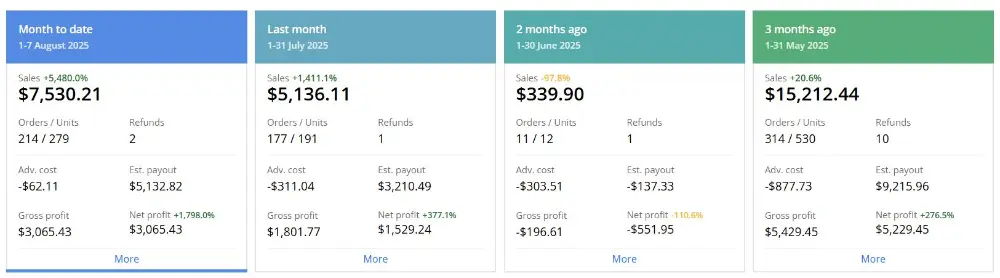
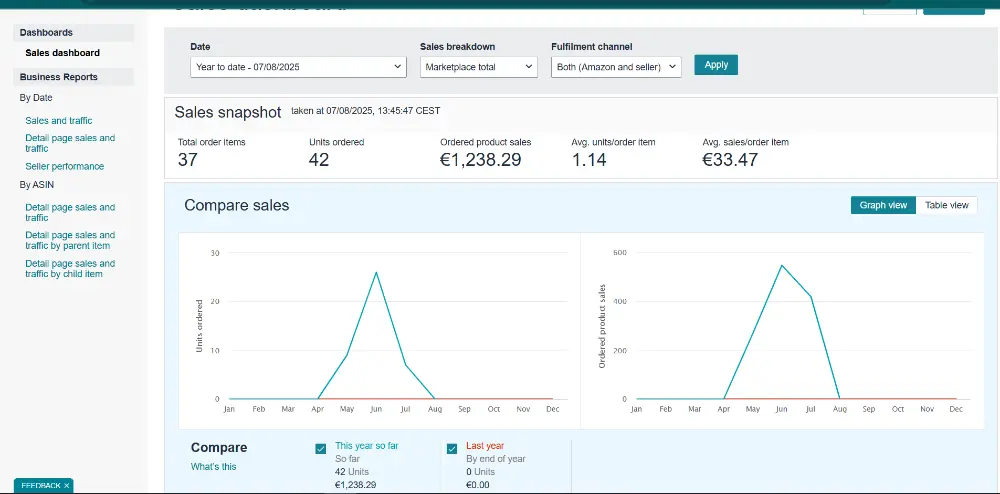
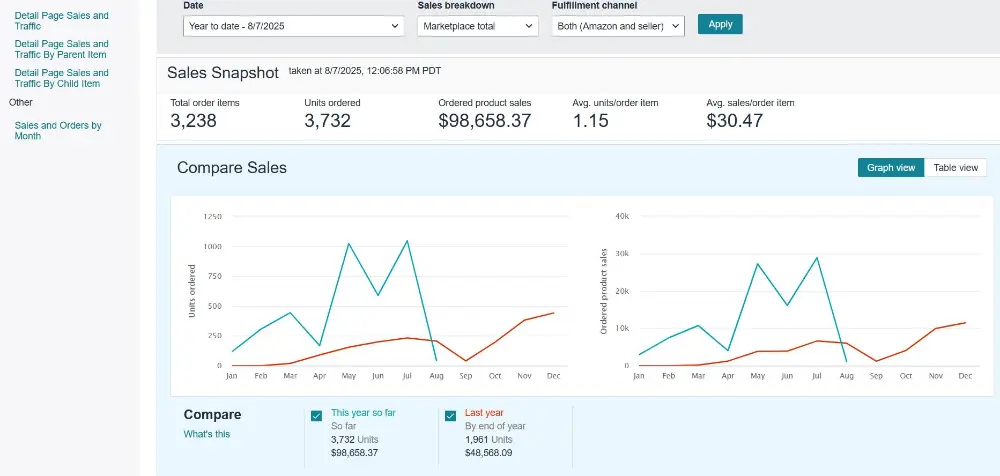
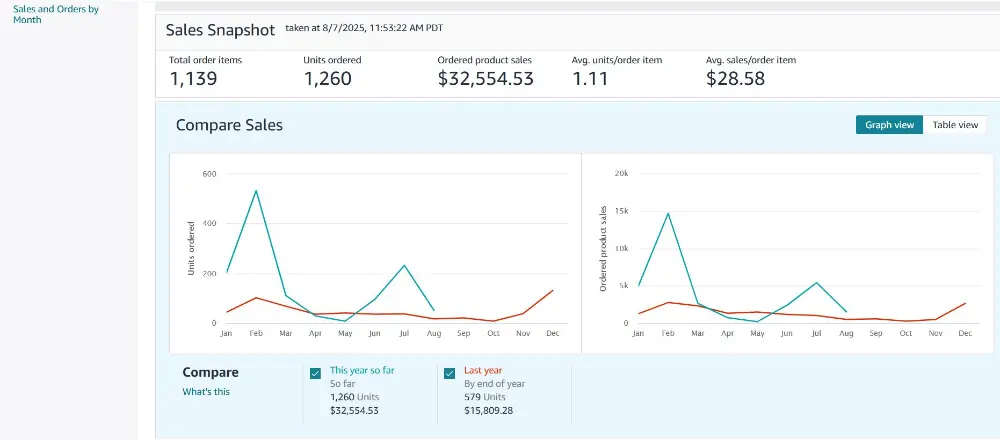
What does a good ACoS look like in real accounts?
Here are results from Amazon accounts we manage, where targets were set from break-even ACoS instead of a generic number.
What ROAS equals a good ACoS?
ROAS (return on ad spend) is the inverse of ACoS. Divide 100 by your ACoS to get ROAS. A 25% ACoS equals a 4x ROAS: $100 in sales from $25 of spend. For more on ROAS, see the Amazon Ads ROAS guide.
| ACoS | ROAS | Meaning |
|---|---|---|
| 10% | 10x | $10 in sales per $1 spent |
| 20% | 5x | $5 per $1 |
| 25% | 4x | $4 per $1 |
| 33.3% | 3x | $3 per $1 |
| 40% | 2.5x | $2.50 per $1 |
| 50% | 2x | $2 per $1 |
A commonly quoted good ROAS is 3x to 4x, which matches a 25% to 33% ACoS. Your break-even ROAS is 100 divided by your break-even ACoS. A 40% break-even needs at least 2.5x to avoid a loss.
Is a high ACoS good or bad?
It depends on why it is high. A high ACoS is fine when it is planned, time-limited and tied to a goal. It is a problem when it is unplanned and stays above break-even.
| Situation | High ACoS OK? | Rule |
|---|---|---|
| New product launch | Yes | Set an end date, usually 4 to 8 weeks |
| Defending your brand terms | Sometimes | Keep it small and track it |
| High lifetime value (subscriptions, repeat buyers) | Sometimes | Only if repeat rates are proven |
| Clearing old inventory | Yes | Sell-through matters more than profit |
| Mature product for months | No | Fix keywords, listing or price |
Should you aim for the lowest possible ACoS?
No. A very low ACoS often means you are holding back on bids and missing profitable sales. Here is an example for illustration. Say your break-even is 35%. Campaign A has $10,000 in ad sales at 12% ACoS, so profit is 23% of $10,000, or $2,300. Campaign B has $30,000 in ad sales at 22% ACoS, so profit is 13% of $30,000, or $3,900. The higher ACoS made more profit because it sold more.
What is the difference between ACoS and TACoS?
ACoS uses only ad-attributed sales. TACoS (Total Advertising Cost of Sales) divides ad spend by total sales, including organic sales. Use ACoS to judge a campaign and TACoS to judge the health of the whole business. If your ACoS is stable and your TACoS is falling, ads are helping organic sales grow.
| Metric | Formula | Best used for |
|---|---|---|
| ACoS | Ad spend / ad sales | Campaign decisions |
| TACoS | Ad spend / total sales | Business health |
| ROAS | Ad sales / ad spend | Quick efficiency check |
Why is your ACoS too high?
High ACoS usually comes from one of two problems: clicks cost too much, or clicks do not convert. Fix conversion first, because a better conversion rate lowers ACoS without shrinking your reach.
| Cause | How to spot it | Fix |
|---|---|---|
| Weak listing | Many clicks, few orders | Improve images, title, price, reviews and A+ content |
| Wasted search terms | Spend with no sales in the search term report | Add negative keywords weekly |
| Bids too high | Average CPC close to your max bid | Lower bids on high-ACoS keywords |
| Broad targeting | Irrelevant terms in the report | Move winners to exact match |
| Wrong price or margin | Break-even ACoS keeps falling | Recheck costs and promotions monthly |
| Returns (apparel) | High ACoS after returns | Push low-return products only |
How do you lower ACoS without losing sales?
- Improve conversion first. Better images, bullets, reviews and price lift sales from the same clicks.
- Prune search terms weekly. Add negative keywords for terms with spend and no sales.
- Harvest winners. Move converting search terms from auto campaigns to exact match with their own bids.
- Adjust by placement. Raise bids where you convert best, such as top of search, and lower them elsewhere.
- Use dayparting if your data supports it. Bid more in peak hours.
- Group by theme. Keep one root keyword theme per campaign for cleaner control.
For the full process, read our Amazon PPC strategy guide.
What mistakes do sellers make with ACoS?
- Copying a competitor target. Their margin is not yours.
- Using only COGS for margin. Include fees, shipping, promos and returns.
- Judging ACoS alone. Check TACoS and profit per order too.
- Pausing keywords too early. Wait for enough clicks.
- Forgetting to update targets. A price, fee or promotion change moves break-even.
- Chasing the lowest number. Total profit matters more than a low percentage.
ACoS is only one number. To judge your agency or your own results, also track TACoS and organic sales, as explained in our guide on how to know if your Amazon agency is working.
Frequently asked questions
What is a good ACoS on Amazon?
Below your break-even ACoS. For many established products that is 15% to 30%, with a safe target 5 to 15 points under break-even.
Is 30% ACoS good on Amazon?
Only if your break-even is higher than 30%. At a 40% margin it is profitable. At a 20% margin it loses money.
Is 50% ACoS bad?
It can be fine during a launch with a time limit. On a mature campaign running for months it is a warning sign.
What ROAS is 25% ACoS?
A 4x ROAS. You earn $4 in sales for every $1 spent.
Is a 3.0 ROAS good?
A 3x ROAS equals a 33.3% ACoS. It is good if your break-even ACoS is above 33.3%, and not enough if it is below.
What ACoS should I target on a new product launch?
Plan to run at or above break-even for about 4 to 8 weeks, then bring it down as reviews and rank build.
Does ACoS include organic sales?
No. ACoS only counts sales attributed to ads. TACoS includes organic sales too.
How often should I update my target ACoS?
Monthly, and whenever price, fees, promotion depth or return rates change.
Conclusion
There is no single good ACoS. Work out your break-even, set a target below it, use higher numbers only on purpose, and track TACoS for the big picture. Use the calculator above any time your costs change. If you want help turning these numbers into campaigns, see our Amazon PPC management service. If ACoS stays high, an Amazon advertising agency can review your account and find the leaks.
Ready to See What Your Ad Account Could Actually Do?
Get a free, no-obligation audit of your Amazon PPC account, we’ll show you exactly where you’re leaving money on the table and what a real strategy would look like.
- Takes less than a minute to submit
- No obligation, no pressure, just a real look at your account
- We’ll tell you honestly if we’re a good fit

The Smart Sellers Edge
AI breakthroughs that help smart Amazon sellers outsell the competition.